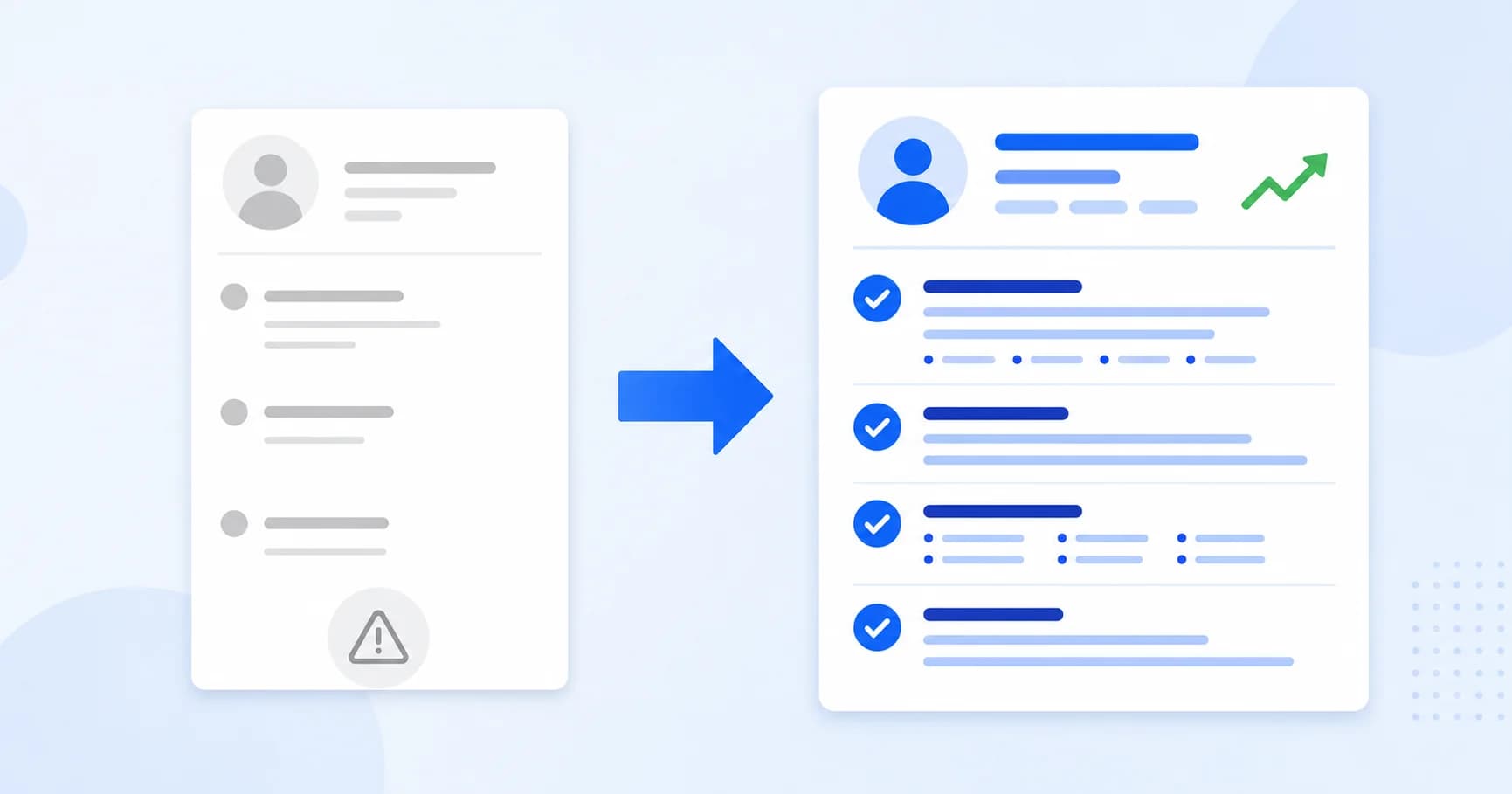

7 CV Mistakes That Make Recruiters Skip in 10 Seconds
Most CV rejections happen before a deep read. A 2018 eye-tracking study by Ladders found that recruiters spend an average of only 7.4 seconds on an initial CV scan. In that narrow window, they are looking for three things: clarity, role fit, and proof of impact. If your CV does not deliver those signals immediately, it gets skipped, regardless of your actual qualifications.
Here are the seven most common mistakes that trigger an instant pass, and how to fix each one.
1. Generic summary with no target role
Many candidates write a summary that could apply to anyone: "Results-oriented professional seeking a challenging opportunity." This tells the recruiter nothing about what you do or what role you are targeting.
Fix: Write a summary tailored to one specific role. Include the role title, your most relevant experience, and a standout metric. For example: "Digital marketing specialist with 4 years of experience driving B2B lead generation. Increased qualified pipeline by 35% through content-led campaigns."
2. Experience bullets that describe tasks, not outcomes
Bullets like "Managed the company social media accounts" describe what you were responsible for, not what you achieved. Recruiters need evidence that you created value.
According to research from TopResume, one of the top reasons CVs are rejected is that they read as job description copies rather than evidence of impact.
Fix: Convert each bullet into action + result + context. Instead of "Managed social media," write "Planned and executed a weekly content calendar across three channels, increasing engagement rate from 2.1% to 4.8% over three months."
3. No measurable results
Numbers create credibility. A CV without any quantified outcomes feels vague and unsubstantiated. Even if your role was not directly revenue-generating, you can quantify efficiency improvements, volume handled, time saved, or team size.
Fix: Audit every bullet point. For each one, ask: "Can I add a number to show scope, speed, or improvement?" Even approximate figures are better than none.
4. Weak keyword alignment to job description
Jobscan reports that over 98% of Fortune 500 companies use Applicant Tracking Systems (ATS) to filter resumes before a human ever sees them. These systems scan for keyword matches against the job description. If your CV uses different terminology (even for the same skills), it may be filtered out.
Fix: Before submitting each application, compare your CV against the job description. Identify the key skills, tools, and qualifications listed, and make sure they appear in your experience section, used naturally within context, not as a disconnected keyword list.
5. Inconsistent structure across sections
Inconsistency in formatting (dates on different sides, varying bullet styles, mixed tense) makes your CV harder to parse, both for ATS software and for human readers who are scanning quickly.
Fix: Choose one structural pattern and apply it across every section. Use the same date format, the same bullet style, and the same order (role → company → dates → bullets) throughout.
6. Overloaded layout that hurts readability
Dense blocks of text, narrow margins, heavy graphics, and multiple columns may look impressive in a design tool, but they often break ATS parsing and slow down recruiter scanning.
A study by the British Psychological Society found that structured, easy-to-scan layouts are rated more favorably by recruiters than visually complex designs, especially in high-volume screening scenarios.
Fix: Use clean, single-column layouts with sufficient white space. Stick to standard fonts. Keep your CV to one or two pages, with the most important information on page one.
7. Missing evidence for core tools and skills
Listing skills in a sidebar or "Skills" section is common, but if those skills never appear in your experience bullets, they carry little weight. Recruiters notice when claimed competencies have no supporting evidence.
Fix: For every skill you list, ensure there is at least one bullet in your experience section that demonstrates how you used it and what resulted from it.
Fast fix framework
Use this simple sequence to improve your CV quickly:
- Rewrite your headline and summary for one target role
- Convert each experience bullet into action + result + context
- Add numbers wherever business impact exists
- Match core keywords from the JD naturally into your content
- Standardize formatting across all sections
- Remove dense layouts and use a clean, scannable structure
You can run this process faster with a free CV review to identify which mistakes are costing you the most interviews.
What to do after fixing CV basics
After your CV is cleaner, the next step is consistent execution. Many job seekers fix their CV once and then return to an unstructured search pattern. Research from the Journal of Vocational Behavior shows that structured job search behaviors (setting goals, planning weekly activities, and tracking progress) are significant predictors of re-employment speed.
Our Career OS workflow helps you sustain that momentum. Then rehearse your story using AI mock interviews to make sure your verbal delivery matches the strength of your written profile.